

NPS Blog
Podcast: Stoking the Entrepreneurial Spirit , with FireDisc’s Griff and Hunter Jaggard
 For years, farmers in West Texas have been using the plow discs from their tractors to cook outside. After all, the metal discs resemble woks when turned sideways, making them perfect for frying bacon and eggs for a crowd or making fajitas on a camping trip.
Two brothers have parlayed that piece of Texas farm culture into an innovative tool: the FireDisc. It’s a portable propane cooking surface that has become required gear among outdoor enthusiasts. 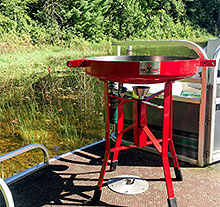
I recently talked to cofounders Griff and Hunter Jaggard about their plans for the FireDisc and the role of customer feedback. They launched their company in 2010 and have been using Net Promoter to help guide their efforts.
You can listen to our conversation through iTunes, Stitcher or through the player below.

4 Responses to Podcast: Stoking the Entrepreneurial Spirit , with FireDisc’s Griff and Hunter Jaggard
-
Recent Posts
- Podcast: The Customer Experience-Based Organization, with USAA’s Julio Estevez-Breton
- Podcast: The Business Lessons of Rejection, with FirstService’s Charlie Chase
- Podcast: Building Temporary Relationships That Last, with Elwood Staffing’s Fernando Cadena
- Podcast: Fostering a Feedback Culture, with Year Up’s Garrett Warfield and Jess Britt
- Podcast: How to Lead with Grit, with Angela Duckworth
Search the Loyalty Blog
Receive new posts by email
Contributors
Categories
Archives
- July 2018
- June 2018
- May 2018
- April 2018
- March 2018
- February 2018
- January 2018
- December 2017
- November 2017
- October 2017
- September 2017
- August 2017
- July 2017
- June 2017
- May 2017
- April 2017
- March 2017
- February 2017
- January 2017
- December 2016
- November 2016
- October 2016
- September 2016
- August 2016
- July 2016
- June 2016
- May 2016
- April 2016
- December 2015
- November 2015
- October 2015
- September 2015
- August 2015
- July 2015
- June 2015
- May 2015
- April 2015
- March 2015
- February 2015
- January 2015
- December 2014
- November 2014
- October 2014
- September 2014
- August 2014
- July 2014
- June 2014
- May 2014
- April 2014
- March 2014
- February 2014
- January 2014
- December 2013
- November 2013
- October 2013
- September 2013
- August 2013
- July 2013
- June 2013
- April 2013
- March 2013
- February 2013
- January 2013
- December 2012
- November 2012
- October 2012
- September 2012
- July 2012
- June 2012
- March 2012
- February 2012
- January 2012
- November 2011
- July 2011
Just listened to this episode and really enjoyed it. So different from the type of thing we hear from high-tech companies. Great examples of continuous improvement, and constant listening to customers. To use a buzzword, I would call it ‘agile’ product development. Get it out there and keep listening and improving.
Hey guys, great episode! My company uses NPS but I believe we are only scratching the surface of analyzing our results. Our typical survey questions include the NPS question, an open-ended comment question, open-ended suggestion question, then questions on key service areas where clients rate our consistency. My concern is, these questions seem diagnostic (what went well, what didn’t) as opposed to behavioral or predictive. I don’t think we have a clear understanding of our clients’ behavior other than satisfied or not satisfied or how that behavior varies based on Promoter or Detractor. Can you guys speak to the ideal design of an NPS survey? A mix of behavioral and diagnostic questions? Ideal question amount? Thanks!
Nick, there’s no “perfect” answer to this. But there is empirical evidence of a few things:
As a result, Bain clients generally keep their requests for customer feedback very short. Likelihood to recommend, impact of the most recent episode on likelihood to recommend, why, and what could we do better. Four questions. A few of our clients add a question or two (no more than four) at the end to verify that the customer’s issue was resolved fully, or to measure specific elements of the experience that have proven to be important for shaping the outcome for customers. But they do this ONLY if they can’t find data in their own systems that would provide the answers to these questions.
Nick, when I see companies ask a series of questions about ‘key service areas’, a question always jumps into my head: Who says they are key areas? These lists of questions are often driven by a desire to provide scores or other feedback to each department in an organization, regardless of whether the customers feel they are key areas or not. In my experience, if a customer never mentions a particular area, you have nothing to improve, and don’t need to worry about it. Indeed, if never mentioned either as an answer to the ‘Why?’ or the ‘What could we do better?’ question, it is probably a hygiene factor, meaning something customers only notice when it goes wrong.
I know Rob likes to use credit card approval as an example fo such a process. Nobody notices it unless it does not work. However, if you decide you absolutely must have a score for the people who handle credit card approval on your team, you will add it anyway.